PK Cable Map 1880's

PK Cable Map 1880's

Thursday, 18 August 2011

Dr WHITEHOUSE'S CURVES

Whilst researching the work carried out by Dr Wildman Whitehouse prior to the laying of the 1858 Atlantic telegraph cable I came across an interesting set of curves plotted by him in June 1857. They relate to measurements he made on a length of cable using his magneto-electrometer ( more on this item to follow) and utilising both voltaic cells and induction coils as an energising source.
The curves were uncovered in the Library & Archives of the Science Museum at Wroughton . Interested to discover whether the shape of the curves were electrically meaningful my colleague Donard de Cogan did some work on them using a tool known as TLM ( Transmission Line Matrix) ...............the results of this work were written up and have been published by the IET in ‘Science Measurement and Technology’ Vol. 5, Issue 4, pp.117-124.

A PDF copy of the paper can be found on the PK website at http://www.porthcurno.org.uk/userfiles/misc_pdfs/wroughton_curves_paper.pdf

So what might one conclude from all that ?
Whitehouse, his instruments and his (alleged) 'non-scientific' approach to his work have all been heavily criticised by historians over the past 150 years. The main reason for this is that he was made the scapegoat for the failure of the 1858 cable and anything and everything he did before or after that event has been largely ignored by by historians. Even present day writers invariably refer to Whitehouse as setting the benchmark for scientific inadequacy. The fact that with his magneto-electrometer he was able to make such sensitive measurements as required to plot the curves goes some way to support an argument that he deserved a rather better 'press' .
As Shakespeare had it in Julius Caesar: ' The evil that men do lives after them; the good is oft interred with their bones'.

Allan Green

Wednesday, 27 April 2011

The Sir John Pender Trophy ?


About 4 years ago I was sent this photograph by an ex-colleague who claims that it was the Sir John Pender Trophy. He believed that it was awarded for some aspect of cable laying, that it was solid silver and had cable routes marked in inlaid gold.

It seems that it had been brought to his attention by a dealer in antiques who knowing of his interests in submarine telegraphy went on to tell him that it had just been sold in Tehran for £1million !


I had forgotten all about it until I came across the photo the other day...............I am not particularly interested but thought that it might be of interest to those researching history of the ETCo........................


Don't tell me it's sitting in the PK archive ! Perhaps, however, there are better photos and something about its history ?


Allan

Wednesday, 20 April 2011

Traffic on the 1858 transatlantic telegraph cable


I have plotted above the number of words received ( i.e. read and understood) at each end of the cable from August 5th, the day it was landed in each country, through to the 1st of September 1858.The traffic west to east clearly got off to a better start and was of higher volume than in the other direction.

There is a lot more to this story which I hope to publish shortly but one thing is worth thinking about...................Note the traffic levels before and after 'the gap' at the 18th August which was the date that Whitehouse was recalled to London, dismissed and replaced by William Thomson on 19th August.


When was it might we suppose that Whitehouse blew-up the cable with his "giant induction coils"........?

Wednesday, 6 April 2011

Highways of the Empire

This would be a great find, if it could be found! In a report of the ETC's Ordinary General Meeting for June 1925, the chairman John Denison-Pender referred to a promotional film that the company that had been shown on its stand at the British Empire Exhibition, the year before. Called "Highways of the Empire", it shows "cable manufacture, cable laying and repairing, and transmission".

I've checked on the BFI catalogue and it's not there so maybe it's at PTM?

Richard

Wednesday, 16 March 2011

George Draper

Just been trying to find some details about cable signalling patents when I came across this part of the BBC's "History of the World" website concerning the transatlantic cables.


There's a comment at the bottom from one Bruce Henderson who says:

"I was very interested to see this item imcluded in the list of 100 objects. My GGgrandfather, George Draper was, for 35 years, secretary to Eastern Telegraph co, which was the company that operated the telegraph systems round the world. In the year of his retirement, 1903, there was an International Telegraph conference in London. I have a book of cuttings and invitations to the various events held. Telegraph Construction and Maintenace Co , of London, which manufactured and laid the cable; notably the original transatlantic cables, using the good ship Great eastern."

It would be fascinating to contact Mr. Henderson and find out what he's got -- unless PTM staff have already done so? Has anybody heard of him?

Tuesday, 15 March 2011

The Mid-Atlantic Ridge


Double click on image for a better view


In PK NEWS Issue 46 John has written an interesting piece, 'Money Mistakes and the Birth of Science' which includes a section about the mid-atlantic ridge.

Making soundings across the Atlantic in the mid 1800's was a long and laborious task. The number of soundings made along a track would to a large extent dictate the accuracy and worth of the exercise. In mid-atlantic it took anything up to four hours to get a line to the bottom and back up again and in some cases bottom was not reached............Lieutenant Maury's measurements were taken as the best available and what he called the 'Telegraph Plateau' would have appeared as very good news to the Atlantic Telegraph Company. Unfortunately he and others who followed were quite wrong about the profile of the sea-bed along the track from Valentia on the west coast of Ireland to Newfoundland.

I have been doing some work recently on this subject with very helpful assistance from Global Marine Services who hold uptodate bathymetric surveys for many parts of the world's oceans including the Atlantic.
With their help we have superimposed a recent survey on the 1850's plots of Lieutenant Maury and British navy man Lieutenant Dayman RN in HMS Cyclops .
In the image above it is difficult to see much detail, however the RED line is the 21st century plot which shows some interesting features:

  • The very steep transition where the Irish shelf ends.
  • The area around 350 nm from the Irish coast which is the zone where it was believed the major fault occurred in the 1858 cable.
  • Right in the centre the very pronounced Mid Atlantic Ridge which the two previous surveys of the 1850's had failed to detect.
As we can see from modern bathymetry the route between Valentia and Newfoundland was anything but a 'plateau' and one might imagine that there would have been some serious doubts about the viability of a transatlantic cable in 1857 had they been aware of the Ridge.


The Ridge itself runs for a great distance (North / South) in the Atlantic extending from the arctic as we can see on the map above. Research continues on this topic particularly to look at just how much more was known ( not known) about the Atlantic sea bed and the Mid Atlantic Ridge by the time the next attempts to lay a cable were made in 1865/6.


Friday, 4 March 2011

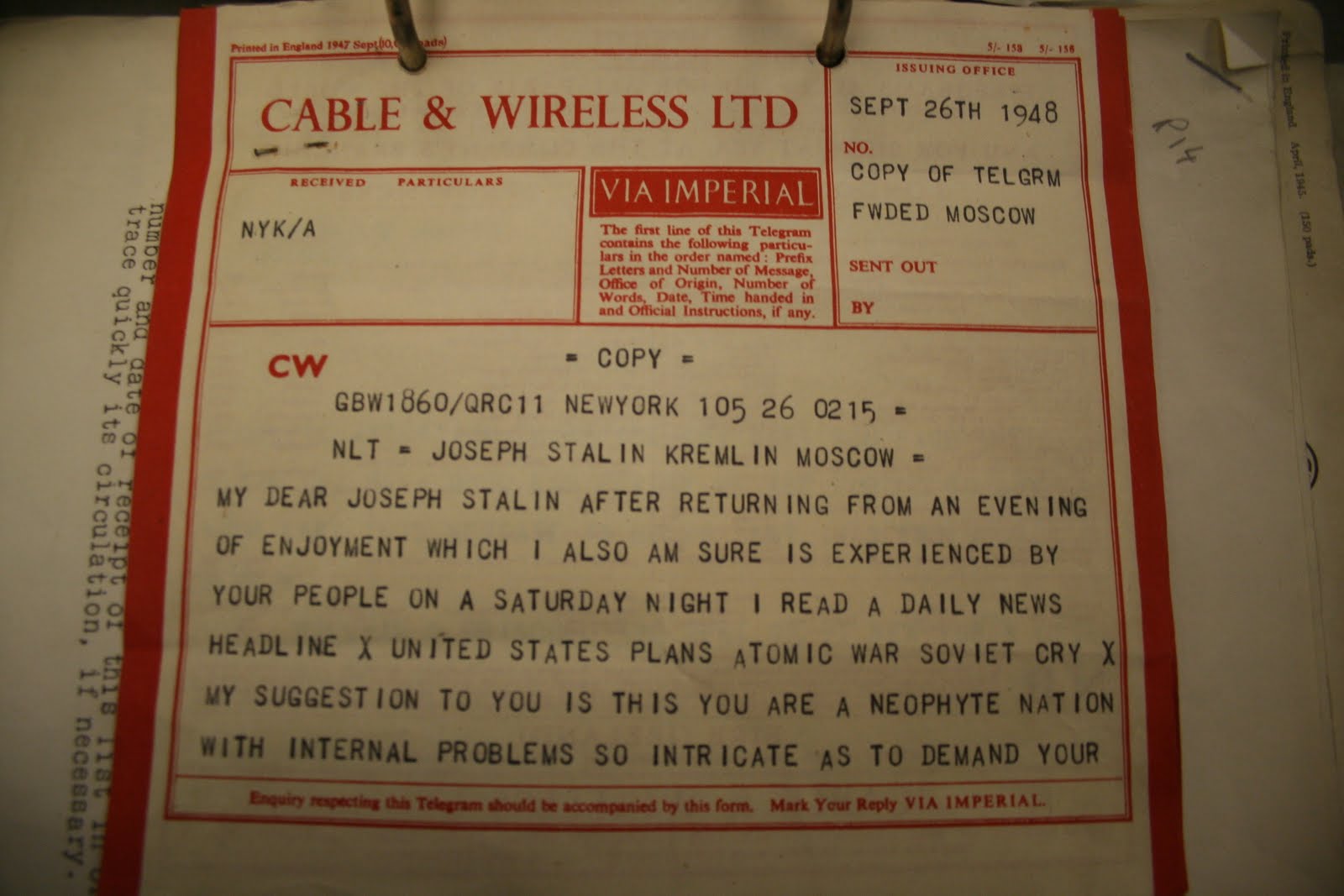
Amusing Post-War Telegram

I came across this telegram on Wednesday in one of the more eclectic files in the archive; I think it speaks for itself. It was intercepted by Cable and Wireless before reaching its final destination...